What Is Change Management — and Why Does It Matter?
Change management is not an additional workstream. It is the key to project success.
In a dynamically evolving corporate landscape, transformation is a constant. Organisational Change Management (OCM) provides a unified framework for navigating change across the entire enterprise — consistently, measurably, and sustainably.
- Structured, organisation-wide change management directly drives business results and ROI by ensuring swift, effective adaptation
- It embeds the capacity to manage change into the organisation's culture and operating model
- It enhances employee engagement, mitigates resistance, and reduces turnover through a consistent, people-centred methodology — supporting long-term commitment
- It significantly reduces the risk of project failure, budget overruns, and schedule delays
Organisational change management is a strategic discipline that delivers competitive advantage over the long term. It is not simply about the success of individual projects — it is about building an organisation's ability to innovate continuously, execute strategy reliably, and maintain a committed, change-ready culture. This creates a stable foundation on which all future transformation can be built.
Research shows that organisations with advanced change management practices are 79% more likely to achieve the goals of their change initiatives — and can realise up to 10–15% cost reduction and 15–20% productivity improvement through well-managed transformation programmes.
Turning Change Into an Organisational Asset
Change management is both a process and a competency. When applied rigorously, transformation outcomes become embedded in the fabric of core projects — not treated as a parallel workstream.
Effective change begins with a clear, structured plan. We work with your organisation to develop a detailed change management framework aligned with your strategic vision — covering corporate goals, key performance indicators, stakeholder mapping, and the scope of each initiative. Every step is grounded in informed decision-making, with full consideration of the impacts the change will have across the organisation.
As a core analytical tool, we use a proprietary stakeholder survey and analysis methodology. This goes beyond identifying the attitudes of key employees — it gives leadership a multidimensional view of how people relate to the change, to one another, and to the organisation itself.
In addition to stakeholder interviews, we assess the organisation's performance measurement systems, people development practices, and project management operations — each of which provides essential inputs for designing the change management framework.
Our Approach: The Five Phases
Preparing for Change
Understanding change creates commitment.
We support the organisation through structured analysis and targeted communication, ensuring leadership and employees have a clear view of the rationale, objectives, and expected impacts of the transformation.
Focus areas:
- Leadership alignment — aligning vision and goals across the senior team
- Stakeholder analysis — identification and attitude mapping
- Readiness assessment — evaluating change readiness and organisational culture
- Change communication — developing core messages and narratives
Developing the Change Management Framework
We design a structured, measurable plan for implementing change — addressing human, operational, and communication dimensions in an integrated way.
Framework elements:
- OCM strategy and action plan
- Stakeholder engagement strategies and impact maps
- Message matrix and communication channel architecture
- Skills assessment and learning curriculum
- Motivation roadmaps and behavioural toolkits
- Performance metrics and evaluation systems
Implementation and Change Support
Change is not simply a tool — it is a fundamental shift in behaviour. Our consultants guide the organisation through every stage of the project, ensuring the new operating model is adopted step by step, with the support structures in place to make it stick.
Supported activities:
- Leadership development and executive coaching
- Operating and supporting the Change Agent Network
- Training design, knowledge transfer, and communication delivery
- Feedback loops and adaptive correction
Embedding the Change
Sustainability is the true measure of success. Changes create lasting value only when they are embedded in the organisation's culture and daily operations.
Outputs:
- Stabilisation of new operating routines
- Feedback collection and performance evaluation
- Long-term competency building and commitment reinforcement
- Framework scalability — transferring the model to future initiatives
Reviewing Progress and Analysing Results
In the final phase, we conduct a structured evaluation of the change initiative's effectiveness. A detailed retrospective analysis determines the extent to which goals were achieved, captures key lessons learned, and provides a clear foundation for future transformations — ensuring that the investment delivers a lasting return.
The Helix 5×5 Model
The design and execution of effective change management is shaped by multiple interacting factors. The Helix 5×5 model provides a structured framework for understanding and adapting to these factors — developed collaboratively with clients, not imposed upon them.
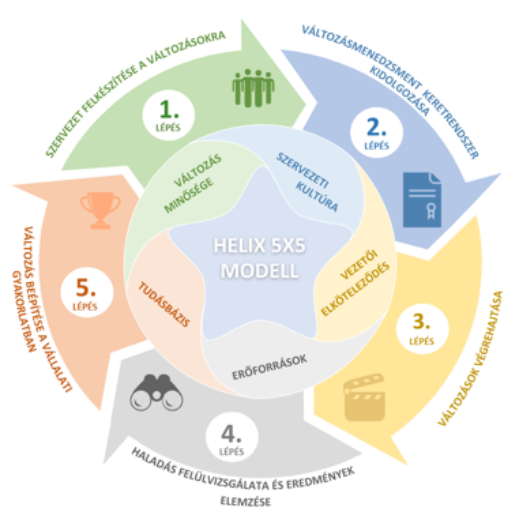
In the 5×5 model, five quality factors govern how each phase is designed and implemented. Awareness and active consideration of these factors are prerequisites for success.
Quality Factors for Successful Change
Nature and Purpose of Change
The quality of any transformation is determined by its root cause, business objective, and the type of solution being implemented. Different situations require different OCM approaches.
Typical areas:
- Artificial intelligence and automation
- Enterprise system implementation (ERP)
- Operational and organisational transformation
- Digital transformation
We align a targeted OCM methodology with each initiative, based on the organisation's starting position and digital/operational maturity.
Organisational Culture and Capabilities
Culture determines how an organisation responds to change. All interventions are grounded in organisational reality.
Assessment dimensions:
- Openness to change and levels of trust
- Communication channels and feedback mechanisms
- Motivation systems and loyalty
- Collaboration and informal networks
- Decision-making structures
- Learning and development practices
The result: an OCM approach that aligns with the organisation's DNA.
Leadership and Commitment
Successful change is fundamentally a leadership challenge. Leaders must not only endorse change — they must visibly shape it.
Key drivers:
- Senior management commitment and active participation
- Authentic role modelling in daily operations
- Consistent communication and decisive action
Leadership development and support are a core focus of our methodology.
Resources and Capabilities
Implementing change requires dedicated expertise and focused attention. We support the organisation in building the capabilities required for transformation.
Elements:
- Developing change management competencies across leadership, project teams, and change agents
- Defining resource allocation and support structures
- Aligning operational processes and governance
Methodological Foundations
The change management framework draws on multiple international methodologies, adapted to the specific context of each organisation. We use an adaptive framework that integrates several proven approaches.
Core pillars:
- Project management methodologies (agile, waterfall, hybrid)
- International OCM models including Prosci (ADKAR), Kotter's 8-step model, and Lewin's change model — augmented by Helix's own field-tested change management toolkit
What the Organisation Gains
Research consistently demonstrates that organisations with mature change management practices outperform their peers:
more likely to achieve positive financial results
more innovative
higher project success rate
Contact us to discuss a tailored change management engagement for your organisation.