Modules
Data and Cost Analysis (DCA)
A rigorous analysis of operational data and cost structures reveals a great deal about how a company actually works. During this analysis, we:

- Review the available data in detail
- Identify the root causes behind anomalies and significant fluctuations
- Map correlations and interdependencies across data sets
- Isolate controllable costs — those that can be reduced through measurable efficiency improvements
The output is a structured report that can be produced on a regular basis and used as the foundation for informed, data-driven business decisions. This enables management to systematically review costs over time, effectively preventing future operational bottlenecks.
Assessment of Corporate Operations and Processes (ACOP)
Data alone rarely captures the full picture of how an organisation operates. That is why we recommend a more comprehensive operational audit — one that takes into account the organisation, its people, its processes, and its tools. Using multi-dimensional assessment frameworks and methodologies, we examine whether current operations are truly optimal:
- Assess organisational structure and hierarchical depth relative to core activities
- Analyse the flow of information and communication channels across business units
- Evaluate the degree of regulation and the alignment of existing governance systems with expected operations
- Examine the extent of digitalisation and the efficiency of systems in use
- Identify unnecessary work, process duplication, and opportunities to reduce administrative burden
- Analyse asset utilisation to maximise efficiency and return on investment (ROI)
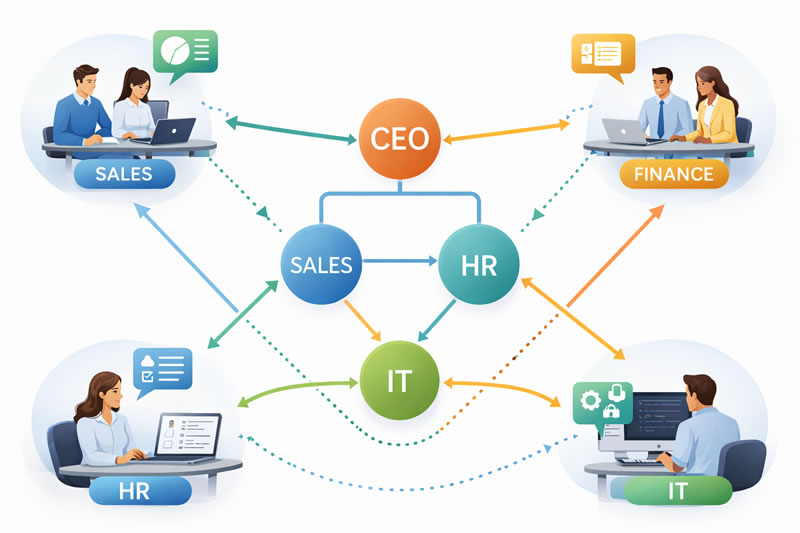
The result is a comprehensive operational diagnosis — delivered on an accelerated timeline, typically within weeks — that clearly identifies the organisation's strengths, weaknesses, risks, and growth opportunities.
Formulation of Efficiency Improvement Measures
Building on the DCA and ACOP diagnostics, we identify strategic pathways to reduce costs, streamline workflows, eliminate process waste, and achieve more effective and profitable operations. Each proposed measure is formulated in detail, clearly structured, and presented in a project-ready format — providing the decision-making foundation needed to initiate implementation.
Efficiency gains are achievable across multiple functions, but the right approach must always be determined on a company-specific basis.
Typical efficiency improvement measures include:

- Organisational and operational streamlining, including the elimination of redundancies
- Addressing labour shortages through task optimisation and role redesign
- Digitalisation, automation, and AI integration across administration, finance, controlling, and core business activities
- Consolidation of IT and other systems
- Exploring outsourcing and insourcing opportunities
- Measuring and evaluating employee performance; introducing and optimising incentive structures
- Introducing, implementing, and monitoring KPIs
- Reviewing and optimising corporate operational processes
- Improving information flow across the organisation
Quantifying the Impact of Measures
Decisions on efficiency improvement initiatives are rarely straightforward, and their projected effects can be difficult to assess with confidence. This is where we add significant value — by modelling the financial outcomes of proposed actions.
We examine and forecast the expected financial impact of recommended changes over the coming years, including projected cost reductions, revenue improvements, and the investment required to deliver them.
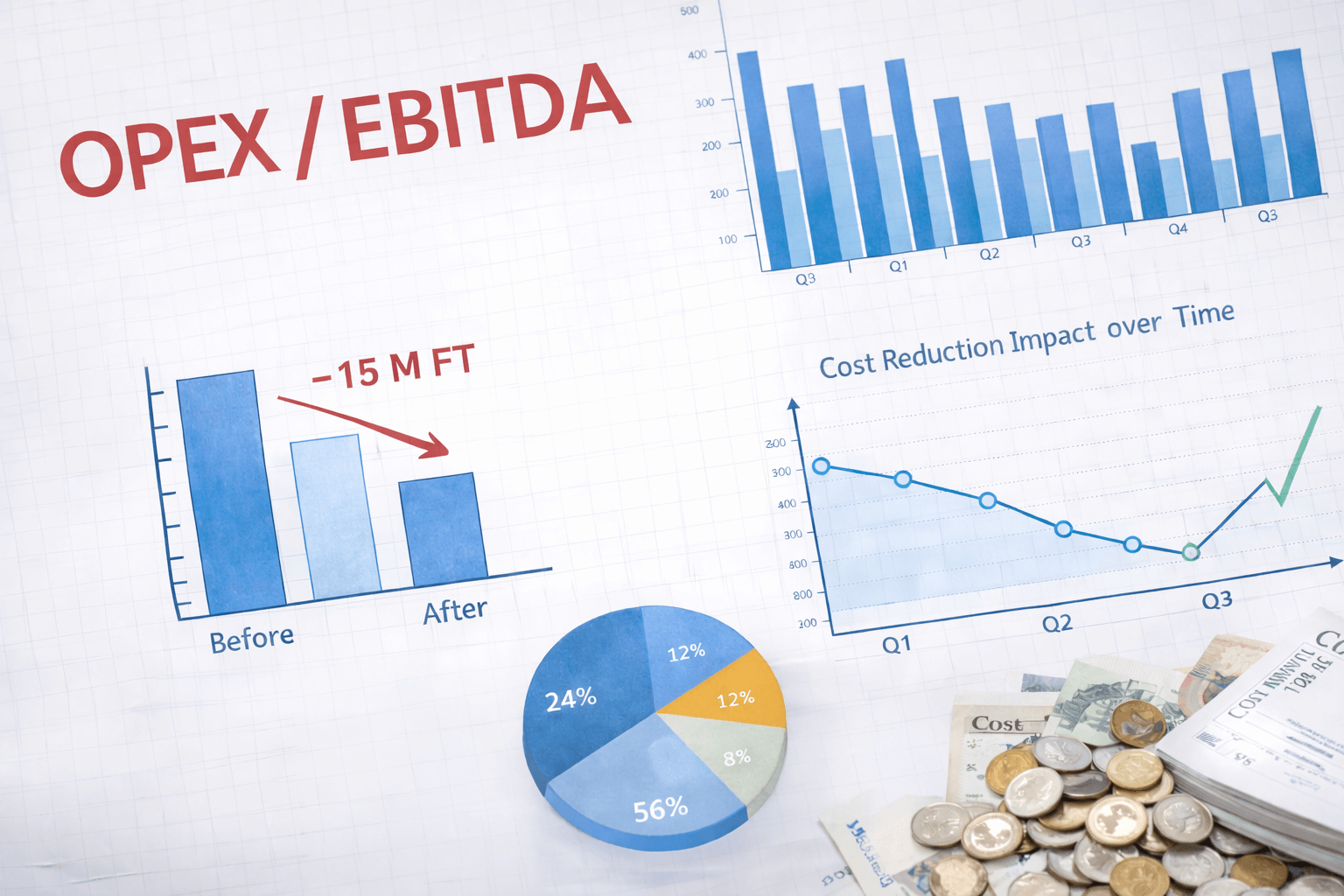
We also calculate the OPEX/EBITDA impact of all adopted measures across the forecast period.
Support Through Implementation

Our consultants are not only available during the initial assessment phase. Where required, we provide hands-on support throughout the implementation of recommended measures.
Drawing on our experienced specialists in process optimisation, system development, organisational development, and project management, we can support the practical execution of change across multiple areas simultaneously.
You can learn more about our management consulting services on our Management Consulting page.
Monitoring
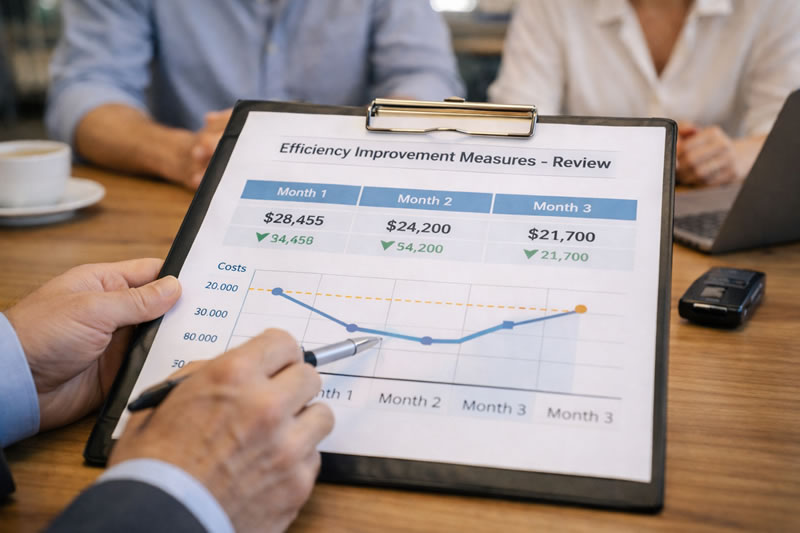
In our experience, efficiency improvement measures only achieve their intended results when they are built into project plans and reviewed at regular intervals — typically every three months. Each review examines whether actions were executed on schedule, how much cost has been saved to date, what has been spent on implementation, whether any obstacles have been encountered, and whether new opportunities have emerged.
Where external constraints prevent a measure from being implemented as originally planned, we typically recommend formulating an equally effective alternative for the relevant area.
Our team is available to support both regular monitoring and the management of unexpected situations.
Change Management
Driving cost reductions through an organisation is never straightforward. In most cases, it encounters internal resistance and the potential for conflict. This is precisely why change management is a critical component of these projects — addressing the human dimension alongside the professional and strategic elements.
Our most frequently applied tools in this context include:

- Stakeholder interviews and analysis to assess initial resistance and understand organisational readiness
- Engaging key experts and leaders through interactive workshops
- Communicating key project updates and milestones to maintain organisational awareness
- Organising open Q&A forums and forums to create direct dialogue opportunities
- Using surveys, feedback mechanisms, and lessons-learned reviews to measure engagement and gather project feedback
Helix has extensive expertise in Organisational Change Management and offers a comprehensive set of proven methodologies. You can read more about our OCM practice on our dedicated Change Management page.